Last Updated: November 19, 2026
Quick Summary
Data destruction compliance for healthcare firms means making PHI unreadable, unusable, and unrecoverable, then documenting it. HIPAA does not name a single destruction method, but it requires secure disposal of ePHI plus records of what was destroyed, when, and by whom. Apply the same standard to any business associate that touches your PHI.
- PHI includes names, dates, medical record numbers, images, billing records, and patient emails or texts.
- NIST SP 800-88 defines three levels: clear, purge, and destroy, with destroy the conservative choice for ePHI leaving your control.
- Degaussing works only on magnetic media and does nothing to solid-state drives or phones.
- A certificate of data destruction should list asset identifiers, method, date, location, technician, witness, and chain of custody.
- Keep the authorization, chain-of-custody log, and certificate together for each disposal event to stay audit-ready.
Table of Contents
- Why Data Destruction Compliance for Healthcare Firms Starts With PHI
- HIPAA Data Destruction Requirements in Plain Terms
- NIST 800-88 Media Sanitization: Clear, Purge, and Destroy
- An End-to-End Destruction Workflow, From Retention to Certificate
- Building a Healthcare Data Destruction Policy Template
- What a Certificate of Data Destruction Must Prove
- Let’s Build Your Program
- Frequently Asked Questions
Why Data Destruction Compliance for Healthcare Firms Starts With PHI
Data destruction compliance for healthcare firms begins with one question: what counts as protected health information, and where does it live?
Healthcare teams that handle secure disposal often find the pattern is consistent.
Protected health information (PHI) is any data that identifies a patient and relates to their health, care, or payment.
The stakes are real. A single drive that leaves your building intact is a potential breach, and breach notification is expensive and public.
What Counts as Protected Health Information
PHI covers far more than a diagnosis. It includes any combination that can identify a person:
- Names, addresses, and dates of birth
- Medical record and health plan numbers
- X-rays, MRI scans, and CT images
Electronic PHI, or ePHI, is the same data stored on drives, servers, laptops, and mobile devices. The HIPAA Security Rule requires safeguards for ePHI at rest and in transit.
Here is the part most guides miss: decommissioned equipment is still in scope. An old MRI console or a retired laptop holds ePHI until the media is destroyed.
HIPAA Data Destruction Requirements in Plain Terms
HIPAA does not name a single destruction method. It requires that you make PHI unreadable, unusable, and unrecoverable, then document it.
HIPAA’s security framework expects covered entities to dispose of ePHI in a way that keeps it from being read or reconstructed, and to document that disposal.
So HIPAA data destruction requirements come down to three things:
- Destroy the media so data cannot be recovered.
- Keep a record of what was destroyed, when, and by whom.
- Apply the same standard to business associates.
That last point matters. If a vendor touches your PHI, you need a business associate agreement and proof of secure disposal.
Paper Records, Electronic Media, and the Disposal Rule
Paper and electronic records follow the same principle but different methods. Paper needs cross-cut shredding. Electronic media needs sanitization or physical destruction.
Medical records on paper still exist in clinics, billing offices, and archived files. Those need secure paper shredding with a certificate that names the destruction date and method.
For drives and devices, the disposal rule points to media sanitization. Retention schedules decide what you keep; the disposal rule decides how you destroy the rest.
A locked shred bin is not destruction. Data sits intact until the paper or drive is actually processed, so chain of custody has to cover that gap.
NIST 800-88 Media Sanitization: Clear, Purge, and Destroy
NIST SP 800-88 gives healthcare firms a decision framework, not a single answer. It defines three levels: clear, purge, and destroy.
- Clear overwrites data with a basic method. Good for media reused inside a controlled environment.
- Purge uses stronger methods, like cryptographic erasure, so data cannot be reconstructed.
- Destroy physically renders the media unusable, often by shredding.
For healthcare, destroy is the more conservative choice for any drive that held ePHI and is leaving your control.
The NIST SP 800-88 guidelines also stress verification and documentation at each step. That is what turns a wipe into evidence.
Wiping, Degaussing, or Shredding: Which Method Fits Which Drive
Match the method to the media, or you will leave data behind. Spinning hard drives, solid-state drives, and tape each behave differently.
| Media Type | Wiping | Degaussing | Shredding |
|---|---|---|---|
| Hard disk drives | Works with verification | Effective | Best for permanent disposal |
| Solid-state drives | Unreliable | No effect | Required |
| Backup tapes | Limited | Effective | Recommended |
| Mobile devices | Unreliable | No effect | Required |
Degaussing only works on magnetic media. It does nothing to a solid-state drive or a phone.
That is why physical destruction is the safer default for end-of-life equipment. Our NIST 800-88 hard drive shredding requirements explained guide covers the specifics.
An End-to-End Destruction Workflow, From Retention to Certificate
A workable workflow has seven steps, and each one produces a record. Skip a step and your audit trail has a hole. The difference between a policy that survives an audit and one that does not is usually not the destruction method, it is whether each step left evidence behind.
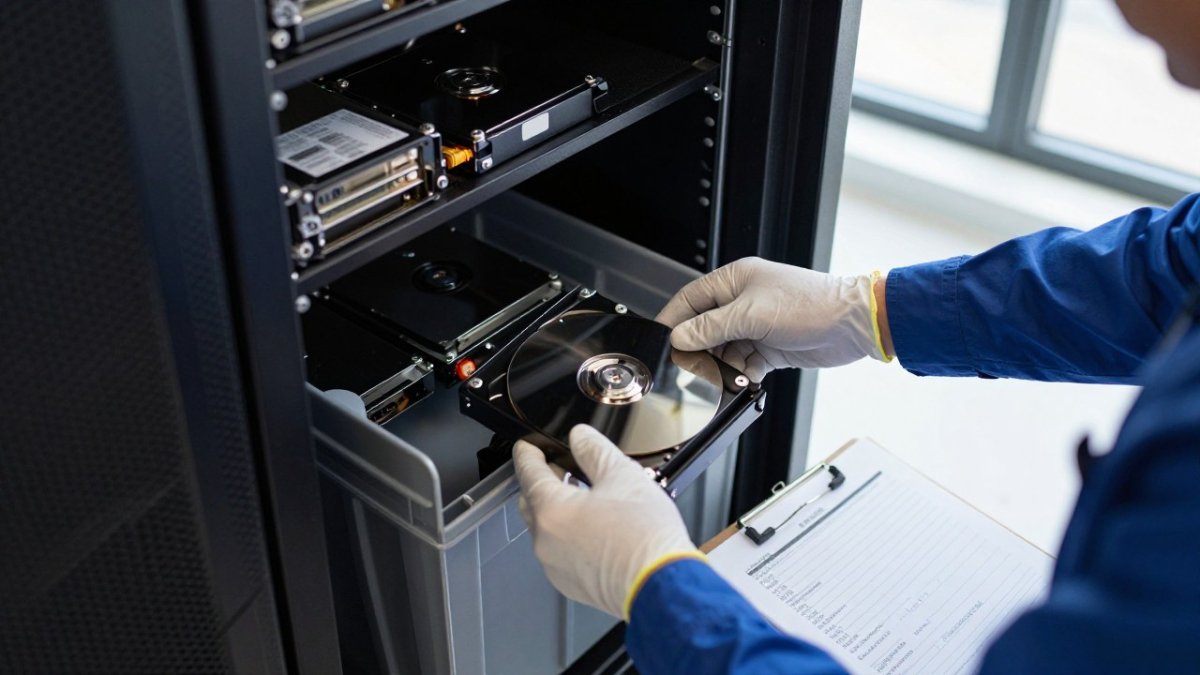
- Inventory every asset and note where PHI lives. Walk the building, not just the server room. Include imaging consoles, front-desk scanners, infusion pumps, backup tapes, and loaner laptops. Record serial numbers, asset tags, location, and media type.
- Apply your retention schedule and flag any legal hold. Confirm the record type, its minimum retention age, and whether a hold, subpoena, or payer audit freezes destruction. This is the authorization step; nothing leaves the building without it.
- Choose the method per media type using NIST guidance. Decide clear, purge, or destroy for each asset and write the choice down. The method decision is itself auditable evidence.
- Sanitize before equipment leaves the building where possible. Wipe or remove storage in place when you can, then verify. Equipment that leaves with data intact depends entirely on the next step.
- Log chain of custody at every handoff. Every transfer between staff, vehicles, and facilities needs a signature, timestamp, and asset count. A gap in the log is a gap an auditor will find.
- Destroy the media, onsite or offsite, with witnesses. Physical destruction should be witnessed and recorded, including the equipment used and the output size.
- Collect the certificate of destruction and reconcile it against the inventory. The certificate is only useful if every inventoried asset maps to a line on it. Reconcile before you file.
The step teams skip most often is number two. Retention and legal holds decide what you are allowed to destroy, and destroying records under hold is its own violation.
Retention Schedules, Legal Holds, and State Rules
Federal law sets a floor, but states add their own medical record retention rules. Many states require adult records be kept for years after the last visit, and minors’ records longer.
Build a retention schedule that names each record type and its minimum age. Then layer legal holds on top.
A practical decision framework:
- Identify the record type and the longest applicable retention period across state law, payer contract, and your own schedule.
- Check for active holds before authorizing destruction; document the check.
- When requirements conflict, follow the longer period and record why.
Watch out: a retention schedule that lives only in a shared drive is not a control.
Cloud, Backups, and Connected Medical Devices
Cloud systems and backups hold ePHI too, and they are easy to overlook. So are connected devices like infusion pumps and imaging machines with internal storage.
- Confirm your cloud vendor destroys data at contract end and gives you evidence of deletion, not just a policy statement.
- Retire backup tapes and drives on a schedule, and include them in the same inventory and certificate process as primary media.
- Wipe or destroy connected medical devices before disposal, and check whether the device stores logs, identifiers, or cached images.
End-of-life equipment is the blind spot. A device that runs a patient monitor may store logs and identifiers long after it is unplugged. The same discipline should extend to cloud-held copies of device data, with Nazca Tech helping connect storage controls to the decommissioning workflow.
Building a Healthcare Data Destruction Policy Template
A healthcare data destruction policy template does not need to be long. It needs to be specific enough that a new hire can follow it.
Include these sections:
- Scope and definitions of PHI and ePHI
- Roles: who approves, who witnesses, who files records
- Retention schedule and legal hold process
Assign clear owners. In practice, most failures trace to nobody owning the disposal step. Name a compliance lead and a backup.
Then test the policy once a year. Pull a sample of certificates and confirm each asset is accounted for.
What a Certificate of Data Destruction Must Prove
A certificate of data destruction is only as good as the details it records. A one-line letter saying “data destroyed” will not survive an audit. The certificate’s job is to let someone who was not present reconstruct what happened to a specific asset.
A solid certificate should show:
- Asset identifiers, like serial numbers or asset tags
- The destruction method used, such as shredding to NIST 800-88
- Date, time, and location of destruction
For healthcare, add the business associate relationship and the media type. That closes the loop between your records and the vendor’s.
Verification and Evidence of Successful Sanitization
Verification is where vendor claims get tested. Ask how the vendor proves data is gone, not just that a drive was collected. The answer should differ by media type, because the evidence differs.
- Hard drives and SSDs: physical destruction produces output that can be described (shred size, equipment used) and, where offered, sampled. A wipe produces a verification report from the sanitization tool.
- Backup tapes: degaussing and physical destruction should be documented with the method and the count processed.
- Mobile devices and connected equipment: factory reset is not destruction; document the storage removal or physical destruction step.
A common pattern is to treat destruction as a single event. It is better treated as a sequence: sanitize, verify, then document.
Watch out: a wipe that was never verified is an assumption, not evidence.
Vendor Due Diligence and Audit-Ready Documentation
Verification also applies to the vendor. Look for documented chain of custody, verifiable destruction methods, and clear certificates of destruction.
Onsite shredding for high-volume ePHI lets you watch the destruction happen. Offsite destruction works when chain of custody is airtight.
To make the file audit-ready, keep three things together for each disposal event: the authorization (retention and hold check), the chain-of-custody log, and the certificate with its verification record. An auditor who can follow one asset from inventory to certificate will not need to sample the rest.
Our guide on how to verify data destruction certificates walks through the checks. And for healthcare specifically, HIPAA-compliant data destruction covers PHI-bearing drives and devices end to end.
Let’s Build Your Program
Healthcare data breaches tied to disposal are often preventable. They commonly trace back to a drive leaving the building, a vague certificate, or no one owning the process.
Erecycler has served more than 112,000 clients and builds its work around NIST 800-88 compliance.
You do not need a massive program to start. You need a documented one. Get a free quote for hard drive shredding, SSD destruction, or onsite data destruction, and we will help you build a program that holds up.
Data destruction compliance for healthcare firms is not a one-time task. It is a repeatable process with records at every step.
Frequently Asked Questions
Does HIPAA require healthcare firms to use a certified data destruction vendor?
HIPAA does not name a specific certification, but the Security Rule requires safeguards that make ePHI unreadable and unrecoverable, and the Privacy Rule makes you responsible for your business associates. That means vetting any vendor for documented methods, chain of custody, and proof of destruction. Look for NIST 800-88-aligned processes, NAID AAA certification, and a certificate of data destruction issued per asset. A signed business associate agreement is also mandatory before any vendor touches media containing PHI.
How do we verify that data on our drives is truly unrecoverable?
Verification depends on the method. For overwriting, keep the sanitization log showing the tool, pass count, and serial number of each drive. For physical destruction, require photo evidence of shredded or crushed media and a certificate listing serial numbers. For degaussing, confirm the field strength meets the media type. Ask whether the vendor performs post-destruction sampling or provides a witnessed destruction option. Documentation tied to serial numbers is what turns a claim into proof during a HIPAA audit or breach investigation.
When can a healthcare organization dispose of records containing PHI?
Only after the record has met its retention period and no legal hold, audit, or open investigation applies. Retention periods come from state medical record laws, payer contracts, and federal rules, and they vary by record type and patient age. Build a retention schedule that maps each record class to its minimum period, then flag anything under legal hold before destruction. Destroying records early can violate state law even when HIPAA would permit it, so check both layers before scheduling disposal.
What documentation should a data destruction vendor provide?
Ask for a certificate of data destruction listing asset serial numbers, the sanitization method used, and the date and location of destruction. Pair it with chain-of-custody records showing every handoff from pickup to destruction, and a business associate agreement. For sustainability reporting, request diversion and zero-landfill metrics. Keep all of it with your HIPAA security documentation, since auditors and breach investigators will ask how end-of-life media was handled.
