Last Updated: October 25, 2026
Quick Summary
NIST SP 800-88 does not mandate a specific machine or particle size for hard drive shredding; it requires that data be rendered unrecoverable using a method validated for the media type, with the decision documented. Shredding falls under the Destroy level, the only level where you no longer trust software, firmware, or a controller.
- NIST SP 800-88 organizes sanitization into three levels: Clear, Purge and Destroy.
- The current published revision is Rev. 2, which replaced the 2014 Rev. 1 document.
- The standard sets outcomes, not equipment, and publishes no universal particle size requirement.
- Degaussing works on magnetic media and does nothing to flash memory chips in SSDs.
- Verification and chain of custody are the steps most disposal programs skip.
Table of Contents
- What NIST SP 800-88 Actually Requires for Hard Drive Shredding
- NIST SP 800-88 Rev. 2 Media Sanitization and Current Revision Status
- Hard Drive Shredding Particle Size: What the Guidance Says Versus Vendor Claims
- HDDs Versus SSDs and Flash Media: Why the Destruction Method Changes
- Verification, Validation and the Hard Drive Destruction Certificate
- The NIST 800-88 Compliance Checklist for Your Disposal Program
- Building Your Shredding Program With Erecycler
- Frequently Asked Questions
What NIST SP 800-88 Actually Requires for Hard Drive Shredding
NIST SP 800-88 is the federal guideline that defines how organizations should sanitize storage media so that data cannot be recovered (Guidelines for Media Sanitization). At Erecycler, we field questions about nist 800-88 hard drive shredding requirements almost daily, and the most common misconception is that the standard mandates a specific machine or a specific particle size. It does not.
The core obligation is straightforward: before any hard drive leaves your custody, you must render the data unrecoverable using a method validated for that media type, and you must document the decision. The standard organizes this into a decision flow of three sanitization levels, which we break down below.
Clear, Purge and Destroy: The Three Sanitization Levels
Clear removes data through logical techniques that protect against simple recovery but leave the drive usable. Purge applies stronger methods that resist laboratory-level recovery attempts. Destroy eliminates the media entirely, so no recovery is possible regardless of effort.
The distinction matters because each level maps to a different risk profile. Clear suits media staying inside your control and being reused for less sensitive work. Purge fits drives leaving your organization for resale or a lower-trust environment.
Shredding sits firmly in the Destroy category. It is the only level where you no longer need to trust software, firmware, or a controller’s honesty.
NIST SP 800-88 Rev. 2 Media Sanitization and Current Revision Status
Revision status is the first thing to pin down, because a procedure written against a superseded document is a documented weakness in your program. NIST SP 800-88, “Guidelines for Media Sanitization,” is published by the NIST Computer Security Resource Center, and the current published revision is Rev. 2, which replaced the 2014 Rev. 1 document (Guidelines for Media Sanitization).
Do not take a vendor’s word for revision status. Verify it yourself before you sign anything:
- Open the NIST Computer Security Resource Center and search for SP 800-88.
- Confirm the publication page shows the revision you expect and note the publication date.
- Download the PDF and check the revision history and the “Errata” or “Updates” section for any issued corrections.
- Ask the provider to cite the section numbers their written procedure references, not just the publication number.
A provider who quotes “NIST 800-88 Rev. 1 compliant” in a proposal is telling you their procedures were written against guidance superseded more than a decade ago. That is a signal to ask questions, not necessarily a disqualifier, but it should trigger a documented review of their procedure against the current revision.
Revision claims are easy to make and rarely checked. Keep a dated copy of the NIST publication page and the vendor’s procedure in your audit file so you can show what guidance was current when the work was performed.
We keep our own procedures mapped to the current revision, and we recommend you ask every provider which revision their written procedure references. The answer should be immediate, not researched on your behalf.
Hard Drive Shredding Particle Size: What the Guidance Says Versus Vendor Claims
Hard drive shredding particle size is where marketing and guidance diverge most sharply. NIST SP 800-88 does not publish a universal particle size requirement for hard drives.
Vendors frequently advertise specific millimeter outputs as if they were a regulatory threshold. They are not. Particle size is a useful proxy for destruction quality, and smaller output generally means lower reconstruction risk, but the standard’s requirement is the outcome: the platters and controller must be physically compromised beyond recovery. The same logic applies across media types, and the practical target changes with the media:
- Magnetic hard disk drives: the platters must be bent, torn, or reduced so the magnetic coating cannot be read. A shred that leaves recognizable platter fragments is not automatically sufficient.
- Solid-state drives and flash media: the flash memory chips are the data-bearing component. Shredding must reduce the chips themselves, not just the enclosure and circuit board.
- Tape and optical media: the recording surface must be destroyed; cutting a cartridge in half may leave readable media inside.
What this means in practice: ask a provider to describe their shred size, their equipment, and how they verify output. A provider who can explain the reasoning behind their size is more credible than one quoting a number as though it were law.
Ask for a sample of the output from a comparable job, or a witnessed demonstration, and compare it to the data-bearing components of the media you are disposing of. If you cannot identify the platters or chips in the output, the process is doing what it claims.
::: Physical destruction remains a critical step in the broader lifecycle of information security, yet extending these rigorous standards to cloud environments is equally vital for maintaining data compliance.
For audit purposes, document the particle size your provider commits to, the equipment used, and the verification method, and keep that record with the certificate of destruction. That record is what lets you defend the destruction decision years later.
HDDs Versus SSDs and Flash Media: Why the Destruction Method Changes
Hard disk drives and solid-state drives fail in completely different ways, so the destruction method has to change with the media. An HDD stores data magnetically on spinning platters. An SSD stores it in flash memory chips soldered to a circuit board.
That difference has a practical consequence. Degaussing works on magnetic media and does nothing to flash. Overwriting can miss data in SSD reserve cells that the controller never exposes.
If you are comparing methods across a mixed fleet, our guide on how to ensure secure hard drive destruction walks through the media-specific decisions in more depth. The short version: do not accept a single method applied uniformly to every device type in your inventory.
Verification, Validation and the Hard Drive Destruction Certificate
A hard drive destruction certificate is the document that proves the work happened, and it is only as good as the process behind it.
Verification is the step most programs skip. It means confirming the destruction occurred as described, whether through witnessed destruction, photographic evidence, or a documented audit trail.
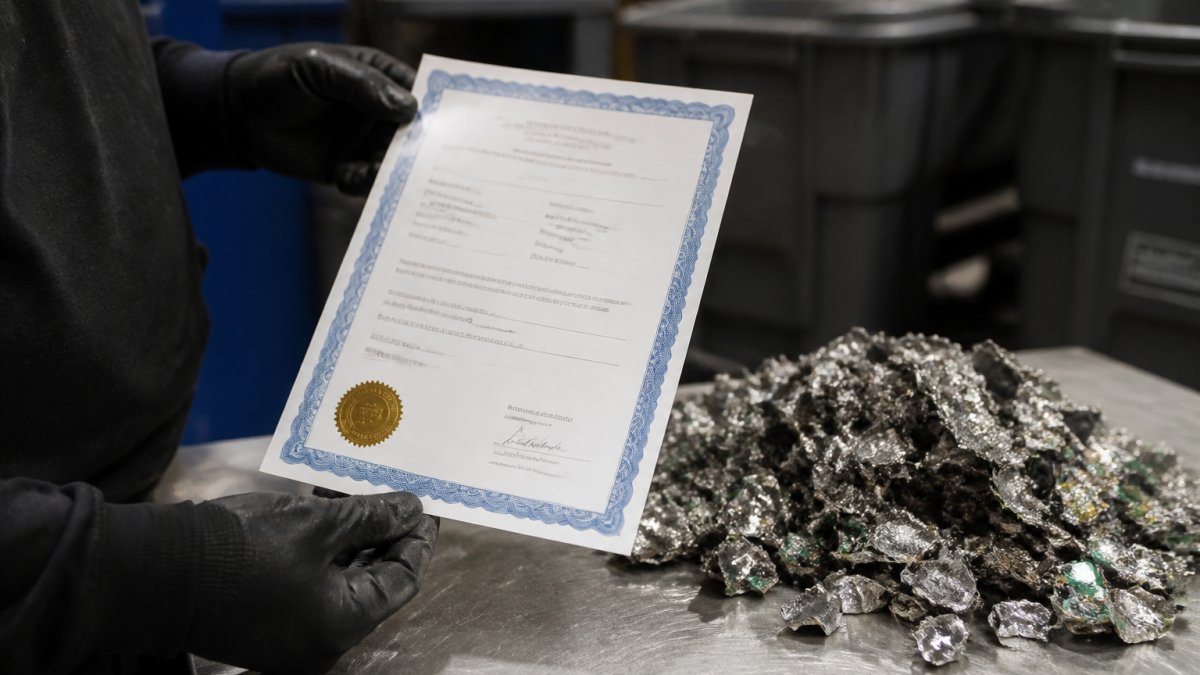
For audit purposes, the certificate should connect to a chain of custody that starts when the drive leaves your rack. Every handoff, every transport leg, every storage location between pickup and destruction needs a record.
The NIST 800-88 Compliance Checklist for Your Disposal Program
Use this checklist to test whether your disposal program meets the guidance. Each item maps to a step the standard expects you to have addressed.
| Step | What to Confirm | Why It Matters |
|---|---|---|
| Inventory | Every drive logged with serial number and media type | You cannot prove destruction of assets you never tracked |
| Risk classification | Data sensitivity assigned per asset or system | Determines whether Clear, Purge, or Destroy applies |
| Method selection | Destruction method matched to HDD, SSD, or flash | A single method will fail on at least one media type |
| Provider validation | Written procedure references current revision | Confirms the process was designed against current guidance |
| Verification | Witnessed or documented proof of destruction | Turns a claim into evidence |
| Certificate | Asset-level certificate issued per device | The document your auditor will ask for |
| Chain of custody | Unbroken record from pickup to destruction | Proves the drive never had an opportunity to be reused |
| Retention | Records retained per your compliance obligations | Audits can arrive years after disposal |
Run this checklist against your current provider before your next disposal cycle. Most gaps show up in verification and chain of custody, not in the destruction itself.
Building Your Shredding Program With Erecycler
A compliant program is a documented program, and that is where most organizations need help. Erecycler has provided secure electronics recycling and data destruction since 1999, with hard drive shredding performed to the NIST 800-88 standard and documented chain of custody for every asset.
We work with clients ranging from single-laptop disposals to multinational data centers, and we build the program around your audit requirements rather than a fixed package. You can review our certifications and audit-ready documentation to see what your compliance officer will receive, and read how we handle hard drive shredding and secure data destruction across onsite and offsite engagements. For teams digging into the standard itself, our NIST compliance page explains how we apply the guidance in practice.
If you are ready to scope a program, request a free quote and we will map the process to your asset volume and reporting needs.
Frequently Asked Questions
Does NIST SP 800-88 require hard drives to be shredded?
No. NIST SP 800-88 does not mandate shredding. It defines three sanitization categories, Clear, Purge and Destroy, and lets the organization choose based on data sensitivity, media type and whether the drive will be reused. Shredding is one physical destruction method that falls under Destroy. For drives leaving your control or heading to disposal, Destroy removes the data recovery risk entirely, which is why many compliance programs default to it.
What shred size is required for hard drives under NIST SP 800-88?
NIST SP 800-88 does not set a numeric particle size for hard drive shredding. It describes destruction outcomes, meaning the media must be reduced so data cannot be reconstructed. Vendors often advertise specific fragment sizes, but those are their own specifications, not a NIST requirement. Ask your provider to document the actual shred size and the equipment used, and confirm the residue is unrecoverable rather than relying on a marketing figure.
How should an organization verify and document hard drive destruction?
Verification means confirming the destruction happened as described, through witnessed processing, serial number reconciliation against your asset inventory, and photographic or video evidence where available. Documentation should include a hard drive destruction certificate listing serial numbers, method, date and location, plus a chain-of-custody record from pickup to destruction. Keep these records with your asset inventory so an auditor can trace each drive from decommissioning to final disposition.
Can a shredded hard drive’s data be recovered?
Once a platter is physically reduced to small fragments, the data is unrecoverable by any practical means. Recovery labs can sometimes pull data from drives that were overwritten poorly or degaussed incorrectly, but shredded platter fragments do not retain readable structures. This is why Destroy is treated as the highest-assurance option in NIST 800-88, and why it suits drives that held regulated data or are leaving your custody permanently.
What is the difference between clearing, purging and destroying media?
Clear uses logical techniques such as overwriting to protect against simple data recovery and suits media being reused in the same environment. Purge uses stronger methods, including cryptographic erase or approved degaussing, to protect against advanced recovery and suits media leaving your control. Destroy physically eliminates the media through shredding, disintegration or incineration and is the only option that guarantees the data cannot be recovered, regardless of who handles the drive afterward.
Does NIST SP 800-88 Rev. 2 replace Rev. 1?
Rev. 2 is the current revision of NIST SP 800-88 and supersedes Rev. 1. It keeps the Clear, Purge and Destroy framework while expanding guidance on modern storage technologies, including solid-state and flash media, and on verification and documentation. If your written sanitization procedure still cites Rev. 1, update it to reference Rev. 2 and confirm your vendor’s process aligns with the current document.
The hard part of NIST 800-88 compliance is not the shredding. It is proving the shredding happened, to the media type, with a record that survives an audit two years later. Erecycler builds that evidence chain into every engagement, with asset-level certificates, documented chain of custody, and sustainability reporting that holds up to scrutiny. Get started with Erecycler and turn your disposal program into documentation your auditor can actually use.
