Last Updated: November 15, 2026
Quick Summary
Verifying data destruction service claims requires four pieces of evidence: a certificate of destruction with a unique ID, a serialized asset list tied to your inventory, a documented chain of custody, and verification records showing how sanitization was performed. Match all three records on serial number first, then quantity, then date and location. A certificate proves a provider said they destroyed something, not that the drive in the truck was the drive in your rack.
- Ask what method, what standard, and what record you will receive for each device, in writing.
- Look up the certificate ID in the issuer’s public directory, not the provider’s PDF.
- NIST 800-88 defines clear, purge, and destroy methods but certifies no one.
- A certificate listing quantities but not serial numbers cannot be reconciled to your inventory.
- Re-verify certifications at least annually and before any large project.
Table of Contents
- What Proof Should a Data Destruction Provider Actually Give You?
- How to Evaluate a Data Destruction Provider Before You Sign
- NIST 800-88 Media Sanitization: What It Requires and What It Doesn’t
- Reading a Certificate of Destruction Line by Line
- Reconciling the Serialized Asset List Against Your Inventory
- Chain of Custody and Verification: Photo, Video, and Witnessed Destruction
- Red Flags and Questions That Expose Weak Claims
- What Verification Can and Cannot Prove, Including Failed Erasures
- Frequently Asked Questions
What Proof Should a Data Destruction Provider Actually Give You?
Verifying data destruction service claims starts with knowing what evidence you are owed. A credible provider should hand you four things: a certificate of destruction with a unique ID, a serialized asset list tied to your own inventory, a documented chain of custody, and verification records showing how the sanitization was performed.
A certificate proves a provider said they destroyed something, not that the drive in the truck was the drive in your rack. Closing that gap is the whole job of verification.
How to Evaluate a Data Destruction Provider Before You Sign
Start with the contract, not the brochure. Ask three questions: What method will you use, what standard does it meet, and what record will I receive for each device?
The evaluation should cover:
- Method: erasure, sanitization, or physical destruction, stated per media type
- Standard: NIST 800-88 media sanitization referenced explicitly
- Scope of service: on-site or off-site destruction, and who witnesses it
A provider can hold a valid certification and still not be certified for the service you are buying. Scope matters more than the logo, check it yourself instead of taking the provider’s word.
Certifications and Their Scope: NAID AAA, R2, and e-Stewards
** A provider can be certified for one service at one facility and uncertified for another.**
Three certifications come up most often in this industry, and they measure different things:
| Certification | What It Covers | What to Verify |
|---|---|---|
| NAID AAA | Data destruction practices and security controls | Current status, service scope, facility listed |
| R2 | Responsible recycling of electronics, including data security | Version, certified facility, downstream handling |
| e-Stewards | Environmental and data-security standards for recyclers | Current listing and scope of operations |
None of these is a substitute for reading the certificate. Check the expiration date, the facility address, and whether the certification covers destruction or only recycling. You can review the standards and compliance documentation we maintain to see what a current, in-scope certification record looks like.
How to Independently Verify a Certification Claim
A certification logo on a proposal is a marketing asset until you confirm it against the issuer’s own records. Work through these steps in order, keeping a dated copy of each finding.
- Get the certificate ID and issuing body in writing. Ask for the certificate number, certifying organization, and exact legal name of the certified entity. No ID means an affiliation, not a certification.
- Look up the ID in the issuer’s public directory. NAID AAA, R2, and e-Stewards each maintain searchable listings. Search the ID and legal entity name, not the brand, a parent company is often certified while the operating subsidiary doing your pickup is not.
- Confirm the scope covers your service. The listing should name data destruction, not just electronics recycling, and specify media types. A facility certified for whole-unit recycling may not be certified for loose drive shredding.
- Confirm the facility address matches where the work happens. If destruction occurs at a different address than the certificate, the certification does not travel with your drives. Compare the pickup ticket address to the listing.
- Check the expiration date and any conditions. Note probation, suspension, or corrective-action status. A certification that lapses mid-contract leaves you with an unverified claim.
- Verify the auditor or accreditation body where the standard uses one. Confirm the certifying organization is itself accredited to issue that certification, the step most buyers skip.
- Re-verify on a schedule. Re-check at least annually and before any large project, and require notification of any status change.
Watch out: a certificate PDF with a logo and a signature line can be fabricated or outdated in minutes, so the issuer’s live directory, not the provider’s document, is the source of truth.
Questions to Put in the Contract
The evaluation is only as good as what you can enforce later. Before signing, get written answers to these and attach them to the agreement:
- Which specific facility will perform the destruction, and what is its certification ID?
- Which subcontractors or downstream handlers touch the assets, and are they certified for the same scope?
- What is the notification window if a certification lapses or a scope changes?
Written answers give you something you can verify. Deflection is a reason to keep looking.
NIST 800-88 Media Sanitization: What It Requires and What It Doesn’t
NIST 800-88 media sanitization is the federal guideline that defines how to render data unrecoverable across media types. It lays out three categories of action: clear, purge, and destroy.
What the guideline does not do is certify anyone. NIST publishes the standard; it does not audit providers.
For hard drives and solid-state media, physical destruction is the most defensible option because no data is left to recover. For a deeper look at what the standard requires in practice, the requirements break down method by method.
Reading a Certificate of Destruction Line by Line
A certificate of destruction is a record stating what was destroyed, how, when, and by whom. Read it like an auditor, because that is who may read it later.
Check for these fields:
- Unique certificate ID that can be independently verified
- Date and time of destruction
- Method used, named specifically
The failure mode here is a certificate that lists quantities but not serials. If your compliance officer needs documentation that holds up under audit, this walkthrough of verifying a certificate covers the independent checks in more detail.
Reconciling the Serialized Asset List Against Your Inventory
A serialized asset list is only useful if it matches your records, device for device. Pull your own inventory and match it line by line: every serial you sent should appear, and every serial on their list should exist in your records.
That sounds simple until you run it against a real inventory, re-tagged devices, unreadable serials, quantities drifting between pickup ticket and certificate. The process below surfaces those problems before an auditor does.
Build the Three-Way Match
Reconciliation is a three-way comparison, not a two-way one. You need:
- Your asset register: the internal record of what you owned, with serial numbers, asset tags, locations, and assigned users.
- The pickup or transfer record: what the provider collected, with counts, dates, and the signature of whoever released the assets.
- The certificate and destruction record: what the provider says was destroyed, how, when, and at which facility.
Match all three on serial number first, then on quantity, then on date and location. A record that matches on count but not on serials is not reconciled, it is a coincidence.
Reconcile Field by Field
Go through each field and decide what a mismatch means:
- Serial number: the primary key. A serial on the certificate not in your register is a data-entry error or a device you did not send; a serial in your register missing from the certificate is an unresolved asset.
- Quantity: compare pickup, certificate, and register counts. Small differences are normal; unexplained ones are not.
- Date: destruction should fall on or after pickup and before certificate issue. A certificate dated before pickup is a red flag.
Watch out: rounded counts and summary lines like “approximately 40 drives” cannot be reconciled to an asset register, so insist on device-level serials even when the volume is large.
Handle the Exceptions Explicitly
Every real reconciliation produces exceptions. What matters is that they are documented and closed, not smoothed over:
- Unreadable or missing serials: record the asset tag, physical description, and reason, and get the provider to note it on the certificate.
- Mixed media: separate drives, tapes, phones, and loose media into their own lines so one method claim does not cover devices it does not apply to.
- Failed sanitization: the record should show the failure and remediation, a second wipe attempt, then physical destruction, with the final outcome for that serial.
Keep the Reconciliation Report With the Certificate
Ask for a reconciliation report as a deliverable, not a favor. A consistent reconciliation trail also makes security reporting more useful by showing how each asset moved from pickup through its documented outcome.
Define retention before service begins. Many organizations keep destruction records for the life of the asset plus a defined period, and some regulated environments require longer.
A reconciled file ties a specific device you owned to a specific documented outcome, the difference between a provider’s claim and your proof.
Chain of Custody and Verification: Photo, Video, and Witnessed Destruction
Chain of custody is the documented, unbroken record of who held each asset from pickup to destruction.
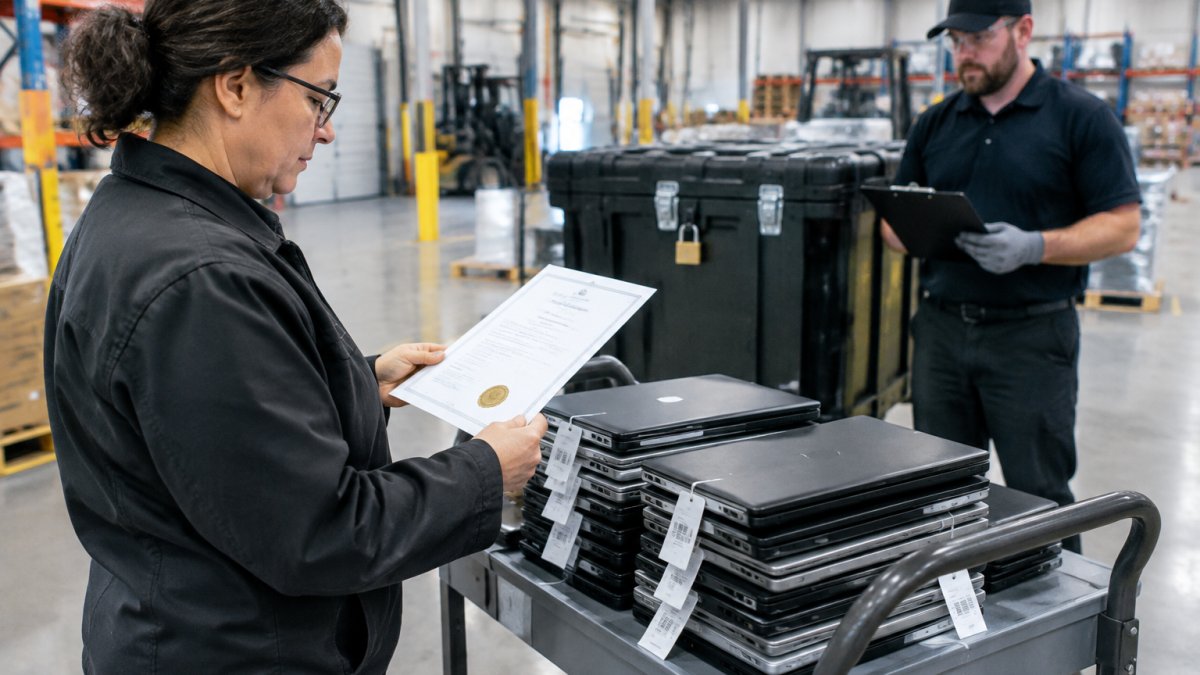
Verification options to request from any provider include witnessed destruction, photo verification, video verification, and scan logs. Ask which of these are offered by default.
For teams that cannot attend in person, the methods for verifying hard drive destruction explain how photo, video, and scan records combine into a defensible file.
Red Flags and Questions That Expose Weak Claims
Weak claims share patterns. A provider who resists specifics is usually protecting a gap.
Watch for these:
- Certificates issued before the destruction date
- Serial lists that arrive only after you ask
- “NIST compliant” with no method named
Ask directly: “Can you show me a sample certificate and asset list from a completed job?” and “Who physically performs the destruction, and are they your employees?” The answers separate operators from brokers.
What Verification Can and Cannot Prove, Including Failed Erasures
Verification proves a documented process occurred and the record matches your inventory. It cannot prove intent or undo a bad method.
A certificate is evidence, not a guarantee. What you control is whether the evidence is complete, reconciles to your assets, and documents exceptions instead of hiding them.
Verifying data destruction claims comes down to one habit: trust the record, not the pitch.
Frequently Asked Questions
Does a certificate of destruction prove that data cannot be recovered?
A certificate is only as strong as the process behind it. It documents what the provider says it did, the method used, the serial numbers covered, and the date. To treat it as proof, match it to your asset inventory, confirm the method meets NIST 800-88 media sanitization for that media type, and check that the provider’s certification scope covers the service performed. A certificate alone does not prove unrecoverability; a reconciled certificate plus chain of custody and verification records gets you close.
How can I verify that a hard drive was securely destroyed rather than resold?
Ask for device-level records: serialized asset lists, the destruction method per device, and photo or video verification of physical destruction. For shredding, request the shred size and a witnessed or recorded destruction session. For erasure, request the erasure report showing the tool used and the pass standard. Then reconcile every serial number on the certificate against your own inventory so nothing is missing. If a provider cannot show device-level proof, treat the claim as unverified.
What should a data destruction certificate include to hold up in an audit?
Look for a unique certificate ID, the client name and service address, the date and location of destruction (on-site or off-site), the destruction method, a full serialized asset list with make and model, the standard followed such as NIST 800-88, and a signature from an authorized representative. For healthcare or financial audits, confirm the certificate ties to a chain-of-custody record and that the provider’s certification was current on the service date.
What are common red flags when vetting a data destruction provider?
Watch for certificates with no serial numbers or only a total device count, certification logos with no certificate number or expiration date, refusal to let you witness destruction, vague answers about where the destruction happens, and pricing that seems too low for the handling involved. Also ask whether the provider resells retired IT assets; if it does, confirm the data-bearing components are removed and destroyed first. Any provider that cannot answer these questions in writing deserves more scrutiny.
