Last Updated: November 22, 2026
Quick Summary
Choosing a professional data destruction vendor means verifying documented methods, independent certifications, and itemized proof rather than accepting a marketing claim. Demand NIST 800-88 media sanitization, serial-number tracking, and certificates of destruction that reconcile against your own asset manifest. Confirm who physically handles your drives, including any subcontractors, and put acceptance criteria in the contract before you sign.
- NIST 800-88 defines clear, purge, and destroy categories for electronic media sanitization.
- On-site destruction keeps chain of custody with you and suits regulated data and small batches.
- Insist on itemized certificates with serial numbers instead of one summary certificate per pickup.
- Watch for hidden costs such as transport fees, per-asset certificate fees, and minimum volume thresholds.
- Reconcile the certificate against your manifest before closing the project or releasing final payment.
Table of Contents
- What a Data Destruction Vendor Actually Does
- NIST 800-88 Media Sanitization: The Standard to Demand
- Security Certifications and Credentials to Verify
- On-Site vs. Off-Site Destruction: Comparing Your Options
- Chain of Custody, Asset Tracking, and Certificates of Destruction
- Pricing Factors and Hidden Costs in Data Destruction
- How to Verify Your Data Destruction Vendor Did the Job
- Building Your Data Destruction Program with Erecycler
- Frequently Asked Questions
What a Data Destruction Vendor Actually Does
Choosing a professional data destruction vendor starts with understanding what you are actually buying: proof that sensitive data no longer exists. A data destruction vendor is a service provider that permanently eliminates data from storage media and documents, then gives you a verifiable record of that work. This guide walks through the standards, credentials, and contract terms that separate a real destruction partner from a company that simply hauls equipment away.
Here is the uncomfortable truth most procurement teams learn late. The vendor’s truck and the vendor’s certificate are not the same thing. One moves your assets; the other protects you in an audit. Most providers do both, but the gap between them is where liability lives.
The work itself falls into a few categories:
- Physical destruction: shredding, crushing, or disintegrating hard drives, solid-state drives, and backup tapes
- Secure data erasure: overwriting or cryptographically erasing media so it can be reused
- Document destruction: shredding paper records that contain confidential information
- IT asset disposition: retiring hardware with asset tracking, value recovery, and e-waste recycling built in
A credible vendor handles all four and documents each step. A weaker one shreds drives and calls it a day. Below, we break down the standards to demand, the credentials to verify, and the pricing traps to avoid before you sign.
NIST 800-88 Media Sanitization: The Standard to Demand
NIST 800-88 media sanitization is the federal guideline that defines how to render data unrecoverable across different storage types. Published by the National Institute of Standards and Technology, it sets out clear, verify, and purge categories for electronic media.
Why does this matter for vendor selection? Because “we destroy your data” is a marketing claim, while NIST 800-88 is a documented method with defined outcomes. Ask any prospective vendor which NIST category they use for each media type. If they cannot answer, that is your answer.
The guideline also distinguishes between media you can clear and reuse versus media that must be physically destroyed. Solid-state drives and modern high-capacity drives complicate older wiping assumptions, which is why media-specific guidance matters. For a deeper walkthrough of the requirements, see NIST 800-88 hard drive shredding requirements explained.
Shredding vs. Wiping: Which Method Fits Your Media
Shredding destroys the physical device. Wiping erases the data but leaves hardware reusable. Choose shredding for drives that will leave your control, fail, or hold regulated data. Choose wiping when you plan to redeploy the asset internally and can verify the result. The NIST media sanitization guidelines are the reference point for both paths.
Security Certifications and Credentials to Verify
Certifications are the fastest filter in vendor due diligence. They tell you an independent body has audited the provider’s security protocols, not just its marketing.
Run this checklist before you shortlist anyone:
- Independent certifications for secure destruction and electronics recycling, verified with the vendor
- Information security management practices, verified with the vendor
- Employee background checks and documented training
- Insurance coverage and liability limits
- Subcontractor disclosure in writing
The last item trips up more buyers than any other. A vendor may be certified while quietly passing work to an uncertified subcontractor. Ask who physically touches your drives. If the answer includes anyone outside the certified facility, get that in the service-level agreement. You can review the certifications and compliance standards we hold to see what a verified credential set looks like.
On-Site vs. Off-Site Destruction: Comparing Your Options
On-site destruction happens at your facility, usually in a mobile shredding unit you can witness. Off-site destruction moves assets to a secure processing plant under locked containers and tracked transport.
| Factor | On-Site Destruction | Off-Site Destruction |
|---|---|---|
| Chain of custody | Stays with you | Transfers to vendor |
| Witnessing | You watch the shred | Limited or video only |
| Best for | Regulated data, small batches | High volume, full ITAD |
| Cost profile | Higher per visit | Lower per device at scale |
| Scheduling | Fixed appointment | Flexible pickup routes |
On-site wins when data sensitivity is high and volume is low. Off-site wins when you are retiring entire data centers and need asset recovery alongside destruction. Many enterprises run both: on-site for drives holding regulated records, off-site for bulk hardware.
Chain of Custody, Asset Tracking, and Certificates of Destruction
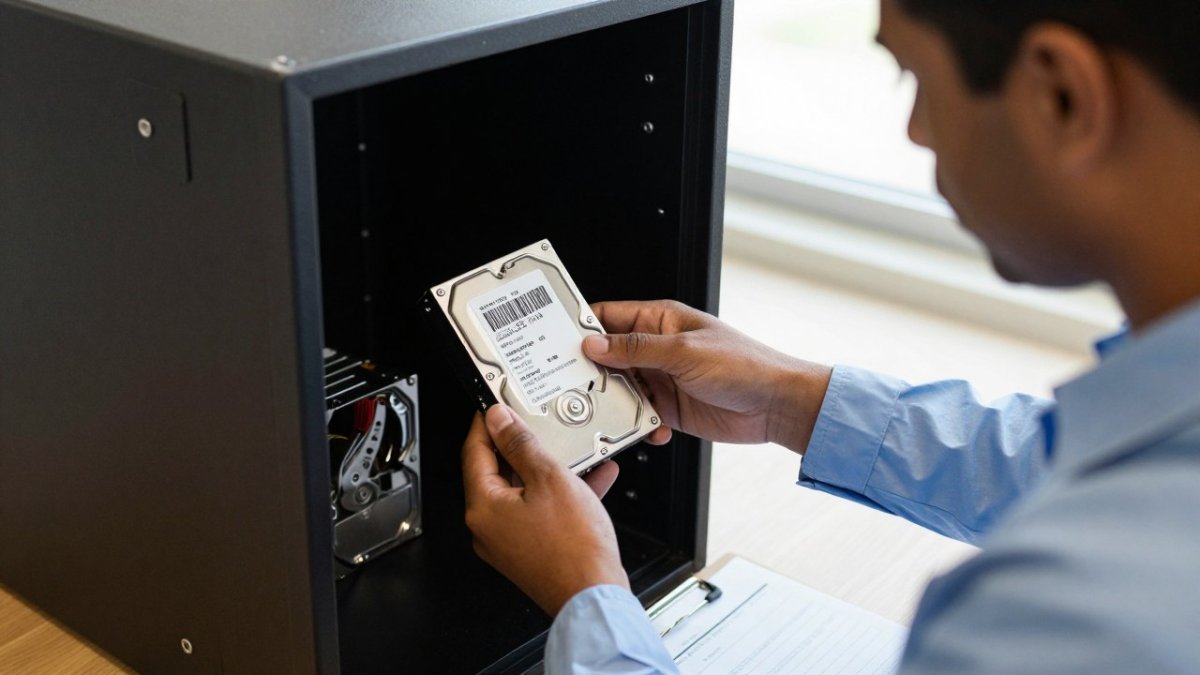
Chain of custody is the documented, unbroken record of who held each asset from pickup to destruction. Asset tracking with serial-number tracking turns that record into an audit trail you can hand to a regulator.
Every asset should be logged at pickup, scanned into a locked container, tracked through processing, and matched to a certificate of destruction. That certificate is your legal proof. Without serial numbers tying it to specific devices, a certificate proves only that something was destroyed.
A common mistake is accepting a single summary certificate for an entire pickup. Insist on itemized records. If your compliance officer needs documentation that holds up in an audit, the record is the product. You can see what a documented chain-of-custody record includes in practice before you request samples from any vendor.
Pricing Factors and Hidden Costs in Data Destruction
Data destruction pricing depends on quantity, media type, service level, and location. Most vendors quote per-device, per-pound, or flat-fee models, and the model you choose changes your total cost of ownership more than the headline rate.
Watch for these hidden costs:
- Transport and pickup fees that appear only after you commit
- Certificate fees charged per asset instead of per project
- Minimum volume thresholds that penalize small businesses
- Rush scheduling surcharges for tight decommissioning timelines
- Asset recovery offsets that quietly reduce your credit
Pricing transparency is a vendor quality signal. A provider that explains its model up front and puts it in writing is usually the same provider that documents its destruction properly. Pricing depends on quantity, dates, and delivery, so request a quote from Erecycler for current rates.
How to Verify Your Data Destruction Vendor Did the Job
Verification is where most procurement processes stop too early. A certificate is a claim. Verification is the evidence behind it, and the evidence has to be specific enough that an auditor, a regulator, or your own legal team can follow it from pickup to outcome.
Set acceptance criteria in the contract, not after the fact. A workable standard has four parts:
- Serial-number reconciliation. Every asset on your pickup manifest must appear on the certificate with a matching serial number, and the counts must tie out. A certificate that lists quantities but not serials proves only that something was destroyed.
- Method disclosure per asset. The certificate should state the sanitization category (clear or purge) or the physical destruction method for each item, not a single method for the whole batch.
- Sampling and verification reports. For wiped or reused media, require a verification sample: the vendor re-scans a defined percentage of drives and provides the tool output. For shredded media, require the destruction record and, where available, video or witnessed destruction for high-risk batches.
- Exception handling. Define in writing what happens when a serial is missing, a drive fails to wipe, or an asset cannot be accounted for. The vendor should notify you within a set window, quarantine the asset, and document the resolution.
A common pattern is to accept a summary certificate because it arrives quickly and looks official. The stronger practice is to reconcile the certificate against your own asset list before you close the project and to hold final payment or release of the vendor’s performance bond until reconciliation is complete.
Watch out: if the certificate’s serial list does not match your manifest exactly, do not treat the difference as a clerical error. Missing serials are the first sign that an asset left the documented chain of custody, and they are the detail an auditor will ask about first.
For high-risk batches, add two steps. Request witnessed destruction or continuous video of the processing run, and confirm the processing facility named on the certificate is the certified facility that actually handled the assets, not a subcontractor. If the vendor resists either request, treat that as a finding in your scorecard rather than a scheduling inconvenience.
Finally, keep the verification record with the certificate. The certificate is the summary; the reconciliation worksheet, the sampling report, and the exception log are what let you answer a regulator’s question months later. For a deeper method, read how to verify data destruction service claims.
Building Your Data Destruction Program with Erecycler
A data destruction program is the repeatable process, not the one-time pickup, that keeps your organization compliant as hardware retires. Erecycler, a family-owned and operated business with 27 years of experience since 1999, provides secure, concierge-style electronics recycling and data destruction, serving clients from single-laptop users to multinational data centers.
We shred hard drives to the NIST 800-88 standard, document chain of custody for every asset, and provide sustainability metrics and diversion reporting for zero-landfill goals. You can visit our IT recycling and data destruction services to start a program or request a quote. As a family-owned and operated business, we build concierge recycling programs around specific client goals.
Retiring hardware without a documented destruction process leaves your organization exposed long after the equipment is gone. Erecycler combines NIST 800-88 hard drive shredding, itemized chain-of-custody records, and zero-landfill recycling into one program you can defend in an audit. Get started with Erecycler and retire every asset with proof in hand.
Frequently Asked Questions
How much does data destruction cost?
Pricing depends on volume, media type, and whether you choose on-site or off-site service. Per-device and per-pound models are both common, and on-site witnessed destruction usually costs more than off-site processing. Ask for a written quote that itemizes transport, certificates, and any minimum pickup fees so nothing surprises you later. For a small batch of laptops, expect a per-device rate; for pallets of server hardware, per-pound pricing often applies. Request a quote from Erecycler for current rates.
How can you verify that a data destruction vendor securely destroys devices?
Demand three things: a certificate of destruction listing serial numbers, a documented chain of custody from pickup to processing, and the option to witness destruction on-site. NIST 800-88 media sanitization compliance should be stated in writing. Ask whether the vendor shreds or resells drives, and get that answer in the service agreement. If a vendor hesitates on any of these, walk away.
Should hard drives be shredded or wiped?
Shredding is the safer default for drives leaving your control, because physical destruction makes recovery impossible and is simple to verify. Wiping, done to NIST 800-88 standards, works when drives will be reused or resold and you need to preserve asset value. The choice depends on your risk tolerance and whether reuse is part of your IT asset disposition plan. Many compliance officers prefer shredding for anything containing regulated data.
What should a certificate of destruction include?
A credible certificate lists the client name, date and location of destruction, device type, serial numbers or asset tags, the destruction method used, and a signature from an authorized representative. It should reference the standard followed, such as NIST 800-88, and confirm the material was destroyed rather than resold. Keep certificates alongside your audit trail; regulators and auditors will ask for them. Erecycler provides documented chain of custody with every job.
