Table of Contents
- What Zero Landfill Electronics Recycling Services Actually Deliver
- Which Electronics Are Accepted (and What Gets Excluded)
- Business Electronics Recycling: Plans That Scale With Your Asset Volume
- Secure Data Destruction Before Anything Leaves Your Site
- The Electronics Recycling Certificate of Destruction: What It Must Contain
- E-Waste Landfill Diversion Reporting: Turning Claims Into Numbers
- Drop-Off, Pickup, and Collection Options: Choosing Your Access Model
- How to Vet a Zero Landfill Electronics Recycling Provider
- Frequently Asked Questions
Last Updated: October 19, 2026
What Zero Landfill Electronics Recycling Services Actually Deliver
Zero landfill electronics recycling services are programs that dismantle and process retired devices so no component ends up in a landfill.
That matters because e-waste is not ordinary trash. Old electronics carry metals, glass, plastics, and sometimes hazardous materials that need special handling.
Here is the part most guides get wrong. Many providers call themselves “green” while shipping whole units to a waste management facility. That is not diversion. Real landfill diversion means you can trace where the metals, glass, and plastics went.
Below, we break down how to pick a provider, prepare devices, and prove your results. We also cover what a recycling program should hand you in writing.
The test of a zero landfill program is documentation, not a slogan. Ask for the paper trail before you hand over a single device.
Which Electronics Are Accepted (and What Gets Excluded)
Most electronics recycling programs accept a broad range of electronic devices, but the list of accepted items varies by vendor and by local rules. Knowing the difference saves you a wasted trip and keeps hazardous items out of the wrong stream.
Common accepted items include:
- Laptops, desktops, and servers
- Monitors and flat-screen displays
- Printers, scanners, and copiers
- Phones, tablets, and networking gear
- Cables, power supplies, and circuit boards
- Keyboards, mice, and small peripherals
Some items get excluded for safety or legal reasons. These often include cathode-ray tube (CRT) televisions and monitors, which carry leaded glass and need special handling. Items with swollen or damaged batteries also need careful authorized disposal. Lamps containing mercury, such as certain backlights, may require separate handling.
Household electronics and business electronics usually follow different rules. Residents can often use a free service at a recycling center. Businesses, schools, and government agencies may need a scheduled pickup instead.
Device-Specific Handling and Safety
Not every device can be treated the same way. A practical zero-landfill workflow separates devices by risk before anything is stacked, packed, or transported.
- Batteries: Lithium-ion and lithium-polymer batteries can catch fire if punctured or crushed. Remove them when the program allows, tape the terminals, and store them in a non-flammable container away from paper and cardboard.
- Swollen or damaged batteries: Do not force a swollen battery into a standard drop-off bin. Place it in a fire-resistant container, keep it isolated, and confirm the provider accepts damaged batteries before transport.
- CRT displays: These contain leaded glass and must go to a processor equipped for CRT dismantling. Do not break the glass; store upright and padded.
- Lamps and backlights: Mercury-containing lamps need separate containment and a recycler that handles universal waste.
- Toner and ink cartridges: Keep them separate from electronics unless the program explicitly accepts them; loose toner can contaminate other material streams.
A common pattern is to stage devices in three zones: reusable or resellable units, units needing battery removal, and units requiring special handling. That simple sort prevents damaged batteries from riding in the same bin as laptops and keeps CRT glass out of a shredder not built for it.
Never put a device with a cracked or swollen lithium battery in a standard drop-off bin. Damaged batteries can catch fire in transit and injure handlers.
Business Electronics Recycling: Plans That Scale With Your Asset Volume
Business electronics recycling works best when the plan matches your volume, not the other way around. A small office with a few laptops needs a different setup than a data center retiring racks of servers. The strongest programs follow a repeatable workflow from inventory to verified final disposition.
A Practical End-to-End Workflow
- Inventory and tag every asset. Record make, model, serial number, and condition. Note which devices hold storage and which contain batteries.
- Sort by disposition. Separate units for reuse or resale, units for refurbishment, and units for material recovery. Reuse and refurbishment come before recycling whenever the device still has useful life.
- Prepare data-bearing devices. Back up needed data, remove accounts, and schedule secure wiping or destruction before anything leaves the site.
- Stage for pickup. Use labeled containers by category and keep damaged batteries isolated.
- Schedule collection. Set recurring pickups or a one-time decommission visit, and confirm chain-of-custody paperwork at handoff.
- Confirm destruction and recycling. Collect certificates of destruction for data-bearing devices and diversion records for material recovery.
- Report results. Tie weights and diversion rates back to your sustainability goals and audit files.
Plans by Organization Size
For smaller businesses, a scheduled pickup or appointment-based drop-off usually covers it. You collect decommissioned devices in one spot, then hand them off in a single visit.
Larger organizations need more structure:
- Recurring collection across multiple sites
- Documented chain of custody for every asset
- IT asset disposition reports tied to each serial number
- Diversion rate tracking for sustainability goals
- Certificates of destruction filed by device and drive serial number
Data center teams face their own challenge. Server hardware must be wiped or shredded before it leaves the building, and every step needs a record. A provider that handles one site well may struggle across several states with different local requirements.
That is where a customized recycling program earns its keep. Ask whether the provider can scale from a single laptop to a full data center decommission without changing vendors, and whether they can supply sample certificates and diversion reports before you sign.
Build a simple asset spreadsheet before your first pickup. Providers can work faster when serial numbers, condition, and disposition are already recorded, and your audit trail starts on day one.
Secure Data Destruction Before Anything Leaves Your Site
Secure data destruction is the step that protects your company, and it must happen before any device moves. A wiped drive and a destroyed drive are not the same thing.
At Erecycler, we shred hard drives to the NIST 800-88 standard. That means the drive is physically destroyed past recovery, not just overwritten.
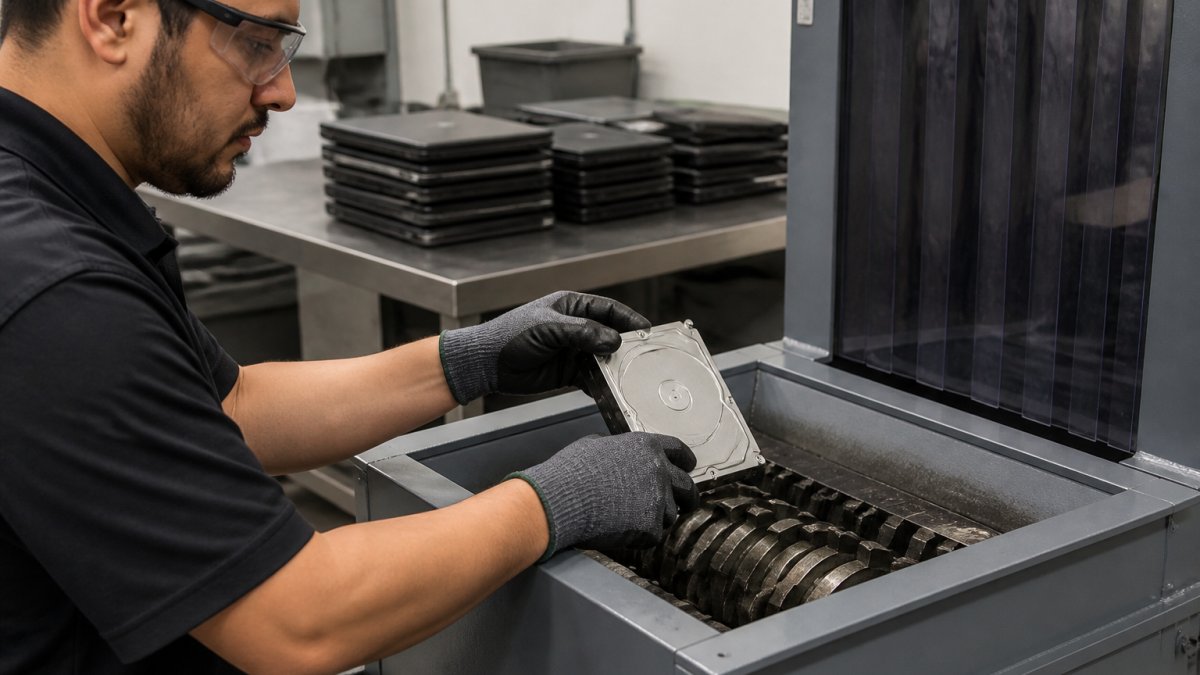
Here is what a solid data security step looks like:
- Inventory every device by serial number
- Remove and destroy drives on site when required
- Log each asset in a chain of custody record
- Confirm destruction in writing before disposal
A common mistake is letting a vendor haul away whole units and “wipe them later.” That gap is exactly where data goes missing. Demand destruction first, then recycling.
Ask for the destruction record to list drive serial numbers, not just device counts. Serial-level logs are what auditors actually want to see.
The Electronics Recycling Certificate of Destruction: What It Must Contain
An electronics recycling certificate of destruction is a written record proving your devices and data were destroyed. It is the document that backs up every claim a provider makes.
A certificate worth keeping should include:
- Company name and date of destruction
- Device and drive serial numbers
- The destruction method used
- A statement of guaranteed data destruction past recovery
- Signature of the technician who did the work
Without these details, the certificate is decoration. Compliance teams need records that hold up if regulators come calling. A vague one-line letter will not survive an audit.
Ask for a sample certificate before you sign a contract. If the provider cannot show you one, that tells you something.
E-Waste Landfill Diversion Reporting: Turning Claims Into Numbers
E-waste landfill diversion reporting turns a promise into a number you can track. Sustainability directors need diversion rate and recycling rate figures for corporate goals, and those figures must be real.
Good reporting shows:
- Total weight collected
- Weight diverted from landfill disposal
- Materials recovered by type (metals, glass, plastics)
- Final destination for each material stream
This is where zero landfill claims get tested. A provider that reports only “units recycled” is hiding the useful detail. You want pounds and material categories, tied to your account.
Erecycler builds sustainability metrics and diversion reporting into every program. That gives your team documented proof, not marketing language, when you report to leadership.
A provider that cannot break diversion down by material type is likely estimating. Estimated diversion numbers fall apart under scrutiny from auditors or sustainability reviewers.
Drop-Off, Pickup, and Collection Options: Choosing Your Access Model
Choosing your collection model comes down to volume and sensitivity. There are three main paths, and each fits a different situation.
| Access Model | Best For | Typical Setup | Watch Out For |
|---|---|---|---|
| Drop-off | Residents, small offices | Bring items to a recycling center | Limited hours, item limits |
| Scheduled pickup | Businesses, schools | Recurring collection visits | Needs storage space on site |
| On-site destruction | Healthcare, finance, data centers | Shredding at your location | Higher coordination effort |
Drop-off suits households and small businesses with a few devices. Check service eligibility first, since some centers only take residential items.
Pickup works for businesses, schools, and government agencies with steady volume. You set an appointment, and the vendor collects on a schedule.
For sensitive data, on-site destruction is the safest route. Devices are destroyed where they sit, so nothing leaves until the data is gone.
How to Vet a Zero Landfill Electronics Recycling Provider
Vetting a provider is about proof, not promises. Anyone can print “zero landfill” on a website. Fewer can show you the records behind it.
Run through this checklist before you sign:
- Can they show a sample certificate of destruction?
- Do they destroy hard drives to a named standard like NIST 800-88?
- Will they provide chain of custody records for every asset?
- Can they report diversion by material weight?
- Do they handle CRTs and batteries with special handling?
- Can they serve multiple sites with different local requirements?
- Do they dismantle devices manually to keep toxins out of the waste stream?
That last point matters more than it sounds. Manual dismantling lets a provider separate materials cleanly and keep hazardous parts out of landfill disposal. A shred-everything approach recovers less and can spread toxins across mixed waste.
A responsible recycling partner will welcome these questions. One that dodges them is telling you what you need to know.
Frequently Asked Questions
What does zero landfill electronics recycling actually mean?
It means no part of a retired device goes to landfill disposal. A zero landfill electronics recycling service dismantles devices manually, sorts metals, glass, and plastics into material recovery streams, and sends what remains to authorized recovery centers rather than a dump. Reuse and refurbishment come first where hardware still works. Ask the vendor how they handle cathode-ray tube glass, batteries, and mixed plastics, since those are the streams most likely to be landfilled. Get the answer in writing before you sign.
How do I verify that an electronics recycler really diverts materials from landfills?
Ask for downstream documentation, not just a certificate of destruction. A credible provider can name the material recovery facilities it ships to, show tracking for each outbound load, and issue e-waste landfill diversion reporting with weights per commodity. Compare the total weight collected against the total weight landfilled; the gap is your diversion rate. If a vendor cannot produce downstream records for a specific shipment, treat the zero-landfill claim as unverified.
How should businesses protect data before recycling computers and other electronics?
Start with an asset inventory so every serial number is accounted for, then decide per device whether it will be reused or destroyed. For anything leaving your control, require secure data destruction to NIST 800-88 standards, with hard drive shredding for drives that held regulated data. Keep drives on site until they are destroyed or wiped, and get a chain-of-custody record signed at pickup. That record plus the certificate of destruction is what a compliance officer needs at audit time.
What documentation should an electronics recycling provider supply?
At minimum: a signed chain-of-custody record, an electronics recycling certificate of destruction listing serial numbers and destruction method, weight tickets per commodity, and diversion reporting for your sustainability goals. For regulated industries, request the downstream vendor list and confirmation that the processor follows federal and state requirements. Erecycler provides documented chain of custody for all assets along with sustainability metrics and diversion reporting, which is the level of detail auditors and sustainability directors typically ask for.
Retiring electronics safely takes more than a pickup truck and a promise. You need guaranteed data destruction past recovery, documented chain of custody, and diversion reporting you can defend. Erecycler brings 27 years of experience, NIST 800-88 hard drive shredding, manual dismantling, and a zero landfill commitment to every program we build. Let’s build your program and turn your e-waste into verified results.