Table of Contents
- Why Managing Electronic Waste Compliance Regulations Is Now a Business-Critical Task
- The Regulatory Landscape: Federal Rules, State E-Waste Laws for Businesses, and Local Requirements
- Your Electronic Waste Recycling Compliance Checklist for Multi-State Operations
- Step 1: Build a site register before you touch a device
- Step 2: Classify each device by waste stream, not by category
- Step 3: Confirm the legal path per site, in writing
- Step 4: Select vendors against the stream, not the brand
- Step 5: Document the chain of custody at every handoff
- Step 6: Store records centrally with a retention clock
- Step 7: Review on a schedule, and after every rule change
- Secure Data Destruction Standards for Businesses: NIST 800-88, ITAR, and Chain of Custody
- Electronics Recycling Documentation Requirements: Recordkeeping, Reporting, and Audit Readiness
- Vendor Due Diligence: How to Verify Certified Recyclers and Downstream Chain of Custody
- Building an Ongoing E-Waste Compliance Program: Ownership, Training, and Monitoring
- Conclusion
- Frequently Asked Questions
Last Updated: October 16, 2026
Why Managing Electronic Waste Compliance Regulations Is Now a Business-Critical Task
Managing electronic waste compliance regulations is no longer a back-office chore, it is a core business risk.
At Erecycler, we have served more than 112,000 clients since 1999, from single-laptop offices to multinational data centers.
Break the rules and you face fines, audits, and damaged trust.
Below: the rules that matter, the documents you need, and the workflow that keeps you compliant in every state.
The Regulatory Landscape: Federal Rules, State E-Waste Laws for Businesses, and Local Requirements
No single law governs electronics disposal, you face three stacked layers of rules.
Electronic waste is any discarded device with a circuit board or power cord: laptops, servers, monitors, printers, phones, and networking gear.
The three layers:
- Federal rules set the floor for hazardous waste handling.
- State e-waste laws for businesses add stricter rules and vary widely.
- Local requirements cover pickup, landfill bans, and reporting.
The EPA’s hazardous waste regulations overview explains the federal framework. Your state agency fills in the rest.
How the Universal Waste Rule and RCRA Affect Electronics Disposal
The Resource Conservation and Recovery Act (RCRA) lets the EPA regulate hazardous waste (the EPA).
The Universal Waste Rule is a lighter set of rules for common items like batteries and lamps.
But the relief is not automatic, some states require full hazardous waste handling for certain devices. Check your state’s rules first.
State-by-State Variations: Covered Electronic Devices and Producer Responsibility
Covered electronic devices are the products a state specifically regulates, and the list varies by state.
Some states run producer responsibility programs, requiring manufacturers to fund or run take-back programs. Buy from those manufacturers and you may get free or low-cost disposal.
Other states put the duty on the device owner, so you carry the cost and paperwork.
A common mistake is assuming your statewide rules cover every facility. Several states layer county or city rules on top, including landfill bans and separate reporting. Skipping the local check is one of the fastest ways to trigger a fine.
Your Electronic Waste Recycling Compliance Checklist for Multi-State Operations
A single-site business can follow one rulebook; a multi-state operation cannot. You need one workflow that adapts to each location and produces evidence, not just activity.
Most guidance stops at “check federal, state, and local rules.” That is not a workflow. Below is the process we walk clients through, with the decision points that change the answer.
Step 1: Build a site register before you touch a device
List every location that retires electronics, even a two-person sales office, and capture:
- Street address and county (local rules often key off county, not city)
- State environmental agency name and the specific program that covers e-waste
- Whether the state runs a producer responsibility program or places the duty on the device owner
This register tells you which rulebook applies where. Without it, every downstream decision is a guess.
Step 2: Classify each device by waste stream, not by category
The same laptop can be universal waste in one state and hazardous waste in another. Classify by the stream the receiving state recognizes:
| Device or Waste Stream | Common Rule Path | Key Action |
|---|---|---|
| Laptops and desktops | Universal waste or state e-waste program | Confirm state classification before pickup |
| Servers and storage arrays | IT asset disposition plus data destruction | Sanitize or shred to a defined standard |
| CRT monitors and older TVs | Hazardous waste in most states | Use a handler permitted for the specific stream |
| Lithium-ion and lead-acid batteries | Universal waste or hazardous waste depending on state | Separate from devices; never commingle |
| Printers and peripherals | Standard recyclable or state program | Remove toner and ink cartridges first |
| Networking gear and phones | Varies; often state e-waste program | Check for data-bearing components |
Batteries are the most common misclassification: a laptop with a swollen lithium-ion pack is not the same waste stream as one with the battery removed, and several states treat them differently.
Step 3: Confirm the legal path per site, in writing
For each site and device class, document the rule you rely on and the source you checked, a one-page determination memo per site naming:
- The federal baseline (RCRA hazardous waste rules, or the Universal Waste Rule where the state has adopted it)
- The state statute or regulation that applies
- Any local ordinance that adds a requirement
EPA hazardous waste regulations overview is the starting point for the federal layer. Your state environmental agency publishes the state layer. The county or city public works department publishes the local layer, and it is the one teams skip.
Step 4: Select vendors against the stream, not the brand
A vendor certified for one waste stream is not automatically certified for another. Match their permits and certifications to the streams on your register; the next section covers verification.
Step 5: Document the chain of custody at every handoff
Every time an asset changes hands, IT to facilities, facilities to the truck, truck to the processing facility, a signed record should capture who had it, when, and where it went next. Serial-number-level tracking holds up in an audit.
Step 6: Store records centrally with a retention clock
Retention periods vary by state and waste stream. Set a retention rule per site in your register and calendar the expiration date, a record you cannot produce on request is the same as no record.
Step 7: Review on a schedule, and after every rule change
Quarterly works for most multi-state operations. Two triggers should force an out-of-cycle review:
- A new state or local rule affecting a site on your register
- A change in your vendor’s certification status or downstream partners
The register is the artifact that makes the rest of the workflow repeatable. If a new site opens, you add a row. If a rule changes, you update one row and know exactly which sites are affected.
Secure Data Destruction Standards for Businesses: NIST 800-88, ITAR, and Chain of Custody
Secure data destruction standards for businesses exist because deleting a file does not delete the data.
NIST 800-88 is the federal guideline for media sanitization, defining how to clear, purge, or destroy data so it cannot be recovered.
Chain of custody is the paper trail proving control, who handled each asset, when, and where it ended up.
A strong program includes:
- A signed transfer record at pickup
- Serial-number tracking for every device
- A certificate of destruction after processing
Ask your vendor for the certificate of destruction before pickup, not after. Seeing the exact fields they capture tells you whether the record will hold up in an audit. If the form is vague, the proof will be too.
Electronics Recycling Documentation Requirements: Recordkeeping, Reporting, and Audit Readiness
Electronics recycling documentation requirements are where most programs quietly fail: teams handle physical disposal well, then lose the paperwork. Treat records as a deliverable of the disposal process, not a follow-up task.
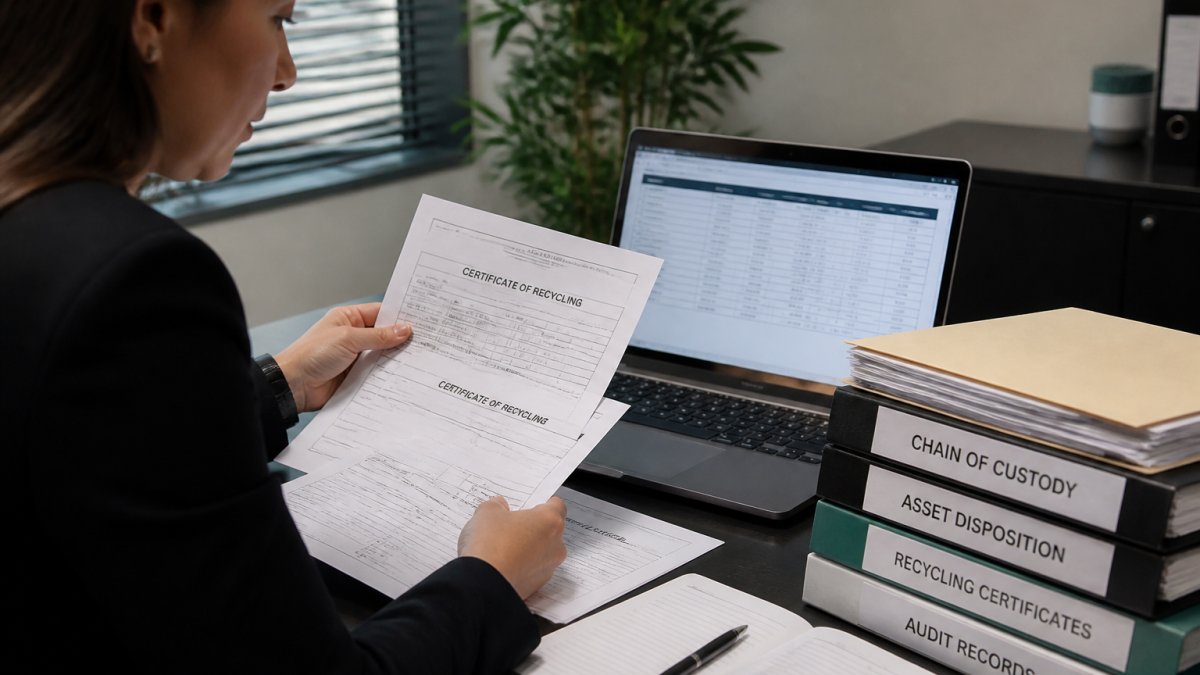
Maintaining these meticulous audit trails serves as the foundation for broader regulatory compliance for offices that must navigate increasingly complex environmental mandates.
The four documents that carry the most weight
Most audits and internal reviews come down to four records. Each has a minimum content standard.
**1.
**2.
3. Vendor certifications and audit reports. Current, not expired, keep the certificate, its scope, and expiration date, plus the downstream partner list and their certifications.
4. State reporting forms and recycling plans. Some states require the device owner to file a plan, an annual report, or both.
What an auditor actually asks for
An audit or regulator inquiry follows a predictable sequence:
- Show me the assets you retired in the period.
- Show me where each one went.
- Show me who handled it and under what authority.
Answer those four questions within a day and you are audit-ready. If any answer requires reconstructing a chain from email, you have a gap even when disposal was clean.
Retention: set a clock per site, not a single number
Retention periods vary by state and waste stream, and some states require several years. Assign a retention period to each site in your compliance register and calendar the expiration date. Two rules:
- Retain for the longer of the state requirement or your own internal audit cycle.
- Never purge a record tied to an open inquiry, a pending vendor dispute, or a device still in the downstream chain.
Reporting deadlines and the data behind them
Where a state requires a report, the deadline is tied to a calendar period, not your disposal schedule, so data must be captured at disposal, not assembled at filing time. Log each disposal event with the fields the report requires (device type, weight or unit count, destination, processing method) so the report is a query, not a project.
A simple structure that survives turnover
Store records centrally, in a structure a new hire can navigate without tribal knowledge:
- By site, then by year
- Within each year, one folder per vendor
- Within each vendor folder, chain-of-custody forms, certificates of destruction, and certifications
If a regulator asks for proof and you cannot produce it within a day, you have a compliance gap even if your disposal was perfect. Records are the program.
Vendor Due Diligence: How to Verify Certified Recyclers and Downstream Chain of Custody
The recycler you hire decides your legal exposure.
Certified recyclers hold third-party certifications proving they meet standards for data security and environmental handling.
Run these checks before you sign:
- Confirm the certification is current, not expired
- Ask where materials go after processing
- Request the downstream vendor list
What most guides miss is the downstream question: a recycler may process devices in-house, then ship parts to other vendors.
At Erecycler, we shred hard drives to the NIST 800-88 standard and provide documented chain of custody for every asset.
Building an Ongoing E-Waste Compliance Program: Ownership, Training, and Monitoring
A one-time cleanup is not a program. Compliance needs an owner, training, and a review cycle.
Name one person accountable for disposal at each site, with the checklist and authority to pause a pickup if paperwork is missing.
Then train everyone who touches the devices, IT, facilities, and office managers. A short annual session covers:
- What counts as regulated waste
- How to log a device for disposal
- Why data destruction must happen before resale
Finally, monitor: review records quarterly, check for rule changes in every state you operate in, and update your vendor list when certifications lapse.
Multi-state operations that need one documented workflow across many sites, with audit-ready records and a single point of contact.
Conclusion
The rules around electronics disposal keep shifting, and a program that worked last year may leave gaps today. The real challenge is staying current across every state, device type, and audit.
Let’s build your program. Get started with Erecycler and turn disposal from a risk into a documented, audit-ready process.
Frequently Asked Questions
What regulations apply to electronic waste in the United States?
At the federal level, the Resource Conservation and Recovery Act (RCRA) and the Universal Waste Rule set baseline handling standards for hazardous components like batteries and cathode-ray tubes. States add their own e-waste legislation, and many ban electronics from landfills entirely. Local requirements can include collection targets and reporting rules. Because rules vary by jurisdiction, businesses should verify the specific federal regulations, state regulations, and local requirements that apply to each facility where end-of-life equipment is generated or stored.
How can a business verify that an electronics recycler is compliant?
Ask for recycling certifications such as R2 or e-Stewards, then confirm them directly with the certifying body. Request documented chain of custody for every asset, downstream vendor lists, and proof of data destruction to recognized standards. A written contract should specify no-landfill commitments, data security controls, and audit rights. Erecycler provides documented chain of custody for all assets and shreds hard drives to NIST 800-88 standards, giving compliance officers records that hold up during regulatory audits.
What records should a business keep when disposing of electronic waste?
Keep a serialized asset inventory, bills of lading, transfer and recycling certificates, data destruction certificates, and downstream vendor documentation. Retain these records for at least three years, and longer if your industry regulator requires it. These documents form the core of your electronics recycling documentation requirements and let you demonstrate responsible disposal, chain of custody, and compliance during an audit. Store them digitally with backups so records survive staff turnover.
How can businesses manage e-waste compliance across multiple states?
Build a jurisdiction matrix that maps each facility to its state e-waste laws for businesses, covered electronic devices, and reporting deadlines. Standardize data destruction to one national standard, such as NIST 800-88, so every site meets the strictest requirement. Use a single vendor with documented downstream chain of custody across regions to reduce complexity. Review the matrix annually, because e-waste legislation changes frequently and new producer responsibility rules can shift your obligations.