Last Updated: October 26, 2026
Quick Summary
Electronic waste management is the systematic process of collecting, handling, storing, and responsibly disposing of unwanted electronics to prevent environmental contamination and recover valuable materials. It protects data, reputation, and the environment while ensuring compliance with federal regulations that now require documented accountability for electronic devices.
- Electronics contain hazardous materials like lead, mercury, and cadmium that leach into soil and groundwater when disposed improperly.
- Secure data destruction to NIST 800-88 standards must happen before any device leaves your organization to prevent data recovery.
- Commercial recycling services provide chain-of-custody documentation, certificates of destruction, and diversion reporting that drop-off and take-back programs cannot.
- Recycling aluminum uses 95% less energy than mining new aluminum, and material recovery reduces energy-intensive mining and refining.
- Organizations should sort devices into three streams: working and resalable, repairable or refurbishable, and end-of-life for material recovery.
Table of Contents
- What Electronic Waste Management Is and Why It Matters
- Types of Electronics and What Can Be Recycled
- Environmental and Health Risks of Improper E-Waste Disposal
- Preparing Your Devices: Data Security and Secure Data Destruction
- E-Waste Recycling Options: Drop-Off, Take-Back, and Collection Events
- IT Asset Disposition for Businesses: Compliance and Documentation
- Measuring Impact: E-Waste Recycling Reporting and Diversion Metrics
- Building Your Electronic Waste Management Program
- Frequently Asked Questions
What Electronic Waste Management Is and Why It Matters
Electronic waste management is the systematic process of collecting, handling, storing, and responsibly disposing of unwanted electronics to prevent environmental contamination and recover valuable materials.
Computers, servers, mobile phones, and other consumer electronics contain hazardous materials including lead, mercury, and cadmium that leach into soil and groundwater when disposed of improperly (the EPA).
Federal regulations now require documented accountability for electronic devices, and state rules vary but the trend is clear: businesses can no longer treat e-waste as someone else’s problem.
Types of Electronics and What Can Be Recycled
Most organizations underestimate what qualifies as recyclable electronics.
We can recycle if it plugs in or holds data.
The key distinction is between devices that can be refurbished and resold versus those destined for material recovery. Refurbishment extends product lifecycles and reduces waste.
Some items require special handling. Devices containing rechargeable batteries, capacitors, or specific hazardous components need careful processing.
Environmental and Health Risks of Improper E-Waste Disposal
When electronics end up in landfills, hazardous materials begin a slow contamination process. Lead and mercury migrate into groundwater, affecting drinking water and agriculture.
A single desktop computer contains more gold than a ton of ore. Multiplied across millions of discarded devices annually, the lost material recovery represents both an environmental and economic loss.
Facilities without proper controls expose workers to toxic dust and fumes.
Improper disposal also creates data security vulnerabilities.
Preparing Your Devices: Data Security and Secure Data Destruction
Before any device leaves your organization, data destruction must be your first priority. Secure data destruction to NIST 800-88 standards ensures data is destroyed past recovery, not just deleted (Guidelines for Media Sanitization).
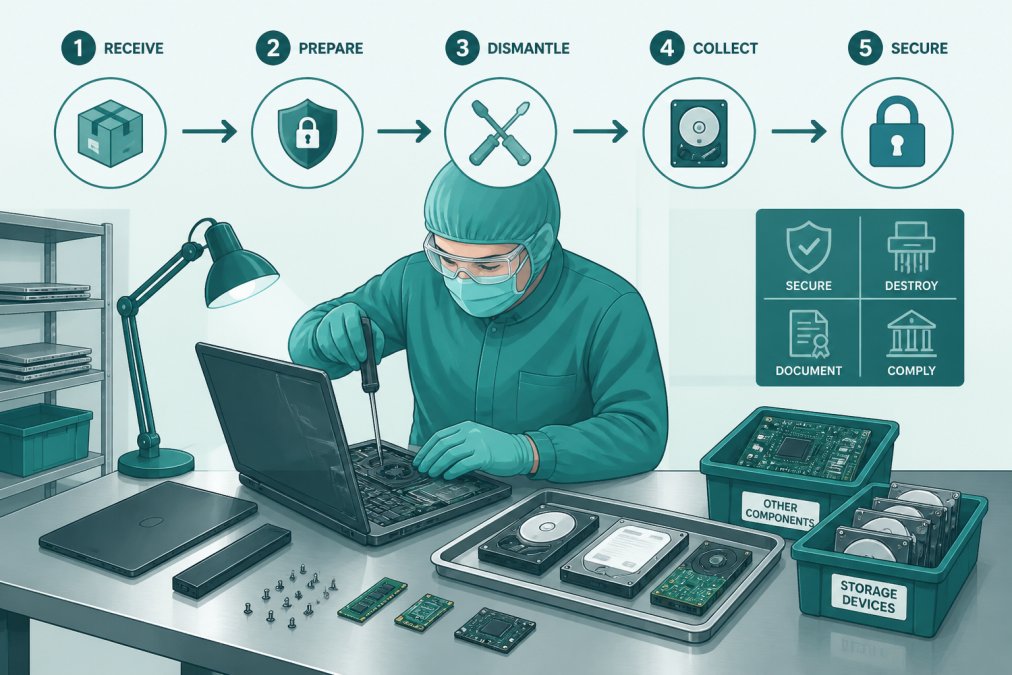
There are two primary methods: cryptographic erasure and physical destruction. Cryptographic erasure overwrites data using encryption standards, rendering it unrecoverable. Physical destruction, shredding hard drives and SSDs, eliminates any possibility of recovery and provides the certainty that matters most for highly sensitive information.
Hard-drive shredding and secure data destruction services ensure your organization meets NIST standards and maintains documented proof. Chain-of-custody records show exactly what was destroyed, when, and by whom.
Before devices reach the destruction facility, remove stickers containing sensitive information, document serial numbers and asset tags, and power down equipment cleanly rather than force-shutting systems down.
E-Waste Recycling Options: Drop-Off, Take-Back, and Collection Events
Organizations have multiple pathways for responsible electronics recycling, and the right choice depends on volume, item type, data sensitivity, and documentation needs. The table below summarizes the practical trade-offs; the sections that follow explain each route.
| Route | Typical cost | Best for | Documentation provided | Key limitation |
|---|---|---|---|---|
| Municipal drop-off | Free to low-cost | Households and small businesses with occasional items | Usually none beyond a receipt | Limited hours, item restrictions, no chain of custody |
| Retailer/manufacturer take-back | Free for accepted items; mail-back kits may carry a fee | Consumer devices in small quantities | Minimal | Often excludes large business equipment |
| Collection events | Free or low-cost | Bulk accumulation during designated periods | Varies; rarely audit-grade | Fixed schedules you cannot control |
| Commercial pickup | Fee-based, quoted per project | Businesses needing scale, security, and reporting | Chain-of-custody, certificates of destruction, diversion reports | Requires scheduling and often minimum volume |
Municipal drop-off locations
Many municipalities maintain e-waste collection centers or periodic drop-off sites. Accepted-item lists vary widely, so confirm hours, residency or business-license requirements, and per-item fees before you load a vehicle. Drop-off works for occasional disposal but becomes impractical at scale: coordinating trips is burdensome, and you typically receive no chain-of-custody record.
Manufacturer and retailer take-back programs
Many manufacturers operate mail-back programs or accept devices at retail locations, and several national retailers run in-store recycling kiosks. These are convenient for consumer devices and small quantities, but generally do not accommodate large-scale business equipment, palletized loads, or the documented destruction compliance requires.
Collection events
Municipalities, counties, and nonprofits organize collection events that accept large quantities of electronics during designated periods, often free or low-cost. The limitation is predictability: set schedules, possible residency restrictions, and rarely audit-grade documentation.
Business electronics recycling services
Commercial recycling services offer scalability and documentation that drop-off, take-back, and collection events cannot match. They handle everything from single devices to data center decommissioning, providing scheduled pickups, documented chain of custody, certified data destruction, and diversion reporting. Pricing is quoted per project based on volume, item mix, and whether data destruction is included. For organizations serious about compliance and sustainability metrics, professional services are the only option that delivers all required components.
Before choosing a route, sort your devices into three piles: (1) working and resalable, (2) repairable or refurbishable, and (3) end-of-life for material recovery. This simple sort determines which route fits each pile and often reduces total cost.
How to choose
Match the route to the job. Use municipal drop-off or retailer take-back for a handful of consumer devices with no sensitive data, and collection events for a one-time cleanout where documentation is not required. Use a commercial service when devices contain regulated data, when you need chain-of-custody and certificates of destruction, when volume makes self-transport impractical, or when you must report diversion metrics.
IT Asset Disposition for Businesses: Compliance and Documentation
IT asset disposition, the process of responsibly managing end-of-life IT equipment, requires more than good intentions. Detailed guidance on IT asset disposition for small business covers the compliance framework that governs how you handle decommissioned hardware.
Federal regulations require documented accountability for electronic devices containing data. HIPAA mandates secure destruction of patient data, GLBA requires financial institutions to destroy customer financial information, and state privacy laws increasingly impose similar requirements.
Documentation is not optional, it’s the proof that compliance happened.
Organizations managing IT assets across multiple states face added complexity, since what complies in one state may not meet another’s standards. Erecycler handles this through customized programs built to specific client goals.
Measuring Impact: E-Waste Recycling Reporting and Diversion Metrics
Sustainability directors increasingly need concrete data on environmental impact. E-waste recycling diversion reporting transforms abstract recycling efforts into measurable outcomes that matter to stakeholders, regulators, and customers.
Diversion metrics track how much electronic waste your organization diverts from landfills, measured in pounds or tons recovered, refurbished, or recycled.
Material recovery tracking breaks down what was actually recovered. How many pounds of copper, aluminum, gold, and rare earth elements were extracted?
Energy impact and carbon reduction matter equally. Recycling aluminum uses 95% less energy than mining new aluminum, and recovering materials from electronics reduces energy-intensive mining and refining (Communicating the Benefits of Recycling | Tools for Local Government Recycling Programs).
Building Your Electronic Waste Management Program
Effective electronic waste management doesn’t happen by accident. It requires intentional planning, clear processes, and ongoing execution. This section walks through the full lifecycle, how to verify a recycler, and how to measure whether the program is working.
Step 1: Inventory and sort
Start by inventorying what your organization actually has: how many devices are in use, the typical lifecycle before replacement, and what is stored or awaiting disposal. Record serial numbers, asset tags, and whether each device holds data. Sort devices into three streams: working and resalable, repairable or refurbishable, and end-of-life for material recovery. This sort determines each device’s downstream path and often reduces total cost.
Step 2: Prepare devices before they leave
Preparation is where data security is won or lost. Back up data, sign out of accounts and device-management profiles, remove SIM and memory cards, and factory-reset devices where appropriate. For devices to be destroyed, confirm the method and whether you need on-site or off-site processing. Document serial numbers and asset tags before pickup so your records match what the recycler receives.
Step 3: Choose and verify a recycler
Not all recyclers handle material the same way. Ask prospective partners where material goes downstream, how they document that destination, and what data-security practices they follow. Look for recognized certifications, and request certificates of destruction and chain-of-custody samples before you sign. A responsible recycler can explain its downstream vendors and provide audit-ready records; an unsafe one cannot.
Cheap recycling can hide downstream risk. If a recycler cannot tell you where material goes or cannot provide chain-of-custody documentation, treat that as a red flag regardless of price.
Step 4: Understand the lifecycle
Once devices leave your site, a responsible recycler follows a defined sequence: collection and intake, sorting and triage, data sanitization or destruction, dismantling and separation, refurbishment and resale where possible, and material recovery for the remainder. Knowing this sequence helps you ask the right questions and interpret the reports you receive.
Step 5: Measure performance
Track metrics that show whether the program is working: collection volume in pounds or tons, reuse and refurbishment rates, material recovery yields, landfill diversion, and verified downstream destinations. These support sustainability reporting and audits. Review them periodically and adjust as volumes and device types change.
Step 6: Assign ownership and document the process
Establish clear ownership and accountability. Assign responsibility for device collection, tracking, and disposition, and document the process so it is repeatable and auditable. Without clear ownership, devices get lost, data-security gaps emerge, and compliance breaks down.
Tell us what needs destroying to get started. Erecycler builds customized electronic waste management programs to your specific requirements. Whether you’re a small business with occasional recycling needs or a multinational with complex compliance requirements, we handle everything from collection logistics to documented data destruction to sustainability reporting.
Frequently Asked Questions
What is electronic waste management?
Electronic waste management is the process of collecting, storing, handling, and responsibly disposing of unwanted electronics such as computers, mobile phones, and consumer electronics. Proper electronic waste management prevents harmful materials like lead and heavy metals from contaminating soil and groundwater, protects data security, and recovers valuable materials through recycling and refurbishment. For businesses, it includes documented chain of custody, compliance reporting, and zero-landfill commitments.
How should businesses protect data before recycling electronics?
Before recycling, businesses must ensure secure data destruction to prevent sensitive information from being recovered. Hard drives should be shredded to NIST 800-88 standards or wiped using certified data destruction methods. Create an inventory of all devices being recycled, document the destruction process with timestamps, and obtain chain-of-custody records from your recycling provider. Never rely on simple deletion or formatting, certified data destruction is the only way to guarantee past recovery.
What happens to electronics after they are recycled?
After collection, electronics undergo material recovery through manual dismantling and processing. Valuable materials like copper, gold, and rare earth elements are extracted and resold. Non-recyclable components are safely disposed of, and hazardous materials are isolated to prevent environmental contamination. Reusable devices may be refurbished and resold. Responsible recyclers track this entire lifecycle and provide diversion reporting showing how much waste was diverted from landfills and how much material was recovered.
How can a business document and report its e-waste recycling?
Work with a recycling provider that offers comprehensive e-waste recycling reporting. Request chain-of-custody documentation for every device, including pickup dates, device descriptions, and destruction certification. Many providers deliver sustainability metrics showing total weight diverted from landfills, material recovery rates, and compliance certifications. These reports satisfy audit requirements for compliance officers and help sustainability directors meet corporate zero-landfill goals. Ensure your provider supplies auditable records that hold up under regulatory review.
Which electronics can be recycled?
Most consumer and business electronics can be recycled, including computers, laptops, mobile phones, tablets, servers, networking equipment, printers, monitors, keyboards, and peripherals. Some programs also accept televisions, microwaves, and other household appliances. Check with your local recycling program or manufacturer take-back service for accepted items, requirements vary by location and provider. Hazardous items like batteries may need separate handling. Always verify acceptance before dropping off devices.
How do I know my data is actually destroyed and not resold?
Demand certified data destruction documentation from your recycling provider. Reputable services provide NIST 800-88 compliance certificates, shredding reports with timestamps, and chain-of-custody records showing your device from pickup through final destruction. Ask whether your provider manually dismantles equipment or uses certified shredding facilities. Verify their certifications and ask for references. Transparent providers welcome audits and provide detailed proof of destruction, if they resist, find another vendor.
Do recycling services work with small businesses?
Yes, many electronics recycling services work with businesses of all sizes, from single-laptop operations to multinational data centers. Small businesses often benefit from concierge-style pickup services that handle logistics, data destruction documentation, and compliance reporting without requiring large minimum quantities. Pricing typically depends on device quantity, weight, and delivery logistics rather than company size. Contact providers directly to discuss your specific needs and learn about options tailored to small business budgets and scale.
